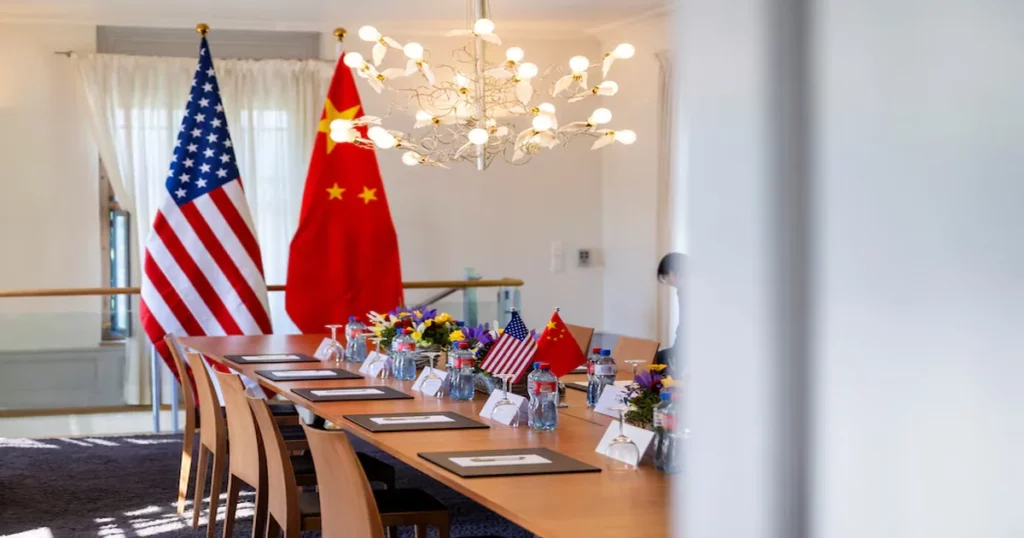
A new Senate report reveals how China is filling the diplomatic void left by the Trump administration’s sweeping cuts to foreign aid and international engagement.
China is rapidly extending its diplomatic footprint across the globe as the United States under President Donald Trump retreats from long-standing international commitments, according to a new report released by Democrats on the Senate Foreign Relations Committee.
The report, the culmination of months of staff research and travel, paints a stark picture of America’s diminishing role in world affairs. While the Trump administration continues to implement major reductions to the State Department and related agencies. Beijing has seized the opportunity to bolster its presence through diplomacy, foreign aid, and strategic investments.
See Also : Senate Reveals Secret Service Failures During Trump Event 2024.
The shift comes amid deep staffing cuts at the State Department, where more than 1,350 U.S. based employees are being let go. These layoffs are part of broader drawdown affecting nearly 3,000 positions and coincide with billions of dollars in foreign aid being slashed. One of the hardest-hit organizations is the U.S. Agency for International Development (USAID), which the report says has been “effectively shut down,” resulting in thousands of contractors and staff being terminated.
The authors argue that these changes are eroding U.S. soft power and limiting Washington’s ability to respond to global challenges.
“In key regions of the world, as the U.S. steps back, China is stepping forward,” the report states. “China is executing a clear and strategic vision for a new international order, one where it hold increased sway, particularly in places where American influence is in retreat.”
The 91-page document catalogs dozens of instances where China has actively stepped in to fill gaps left by American withdrawal. These include critical sectors like health, infrastructure, energy, and education.
See Also : Kentucky Church Shooting Leaves Three Dead.
In Africa, for example, as the U.S. ended food assistance programs, China donated $2 million in rice to Uganda. After Washington terminated a $37 million HIV/AIDS grand in Zambia earlier this year, Beijing announced it would provide 500,000 rapid HIV testing kits and pledged to strengthen its partnership on public health in the region.
In Southeast Asia, Chinese President Xi Jinping’s diplomatic tour through Vietnam, Cambodia, and Malaysia yielded major agreements. In Vietnam, discussions led to enhanced rail connections. In Cambodia, the Chinese government signed 37 new cooperations deals spanning infrastructure, education, and energy sectors. Malaysia received pledges for technical cooperation and manufacturing development.
Latin America has also become a major focus of Chinese outreach. In May, China hosted the China- Latin America and Caribbean Forum, during which it committed $9 billion in credit lines and additional infrastructure investments to the region.
The report emphasizes how China’s growing diplomatic influence is not merely symbolic. “This is not about rhetoric,” it reads. “China is executing a comprehensive plan to reshape the balance of global influence.”
Meanwhile, Trump administration officials defend the cuts as necessary to advance the “America First” agenda. The White House insists that reducing foreign aid and shrinking the size of federal workforce are essential steps toward eliminating wasteful spending.
“Our foreign policy is no longer dictated by donors or globalists,” said a senior White House official who spoke anonymously. “We’re focused on what benefits American citizens first.”
But the Democrats’ report argues the long-term costs could be catastrophic. It cites research from the Lancet medical journal warning that dismantling USAID programs could lead to more than 14 million additional death by 2030 due to lost access to critical health services.
Committee researchers further claim that U.S. efforts in international broadcasting, development, and strategic alliances are being dwarfed by China’s increasingly sophisticated global operations. They warn that Beijing’s influence could sway future generations in emerging economies and diminish America’s ability to rally international support for its values.
Senator Chris Murphy, one of the lawmakers behind the report, said in a statement, “We are watching in real time as America cedes the field to China, and we’re doing it voluntarily. This is not about ideology. It’s about whether we’re willing to show up and compete.”
The authors call for an urgent re-evaluation of current policies. Their recommendations include restoring funding for diplomatic programs, reviving USAID operations, and engaging more robustly with allies to counterbalance China’s rise.
They also stress the importance of bipartisan support for U.S. leadership abroad. “Global engagement should not be a partisan issue,” the report concludes. “It is a matter of national security and international stability.”
While the Trump administration continues to emphasize self-reliance and lean governance, the report underscores that in diplomacy, as in nature, vacuum never lasts long. And for now, it is China that is moving in to occupy the space left behind.


