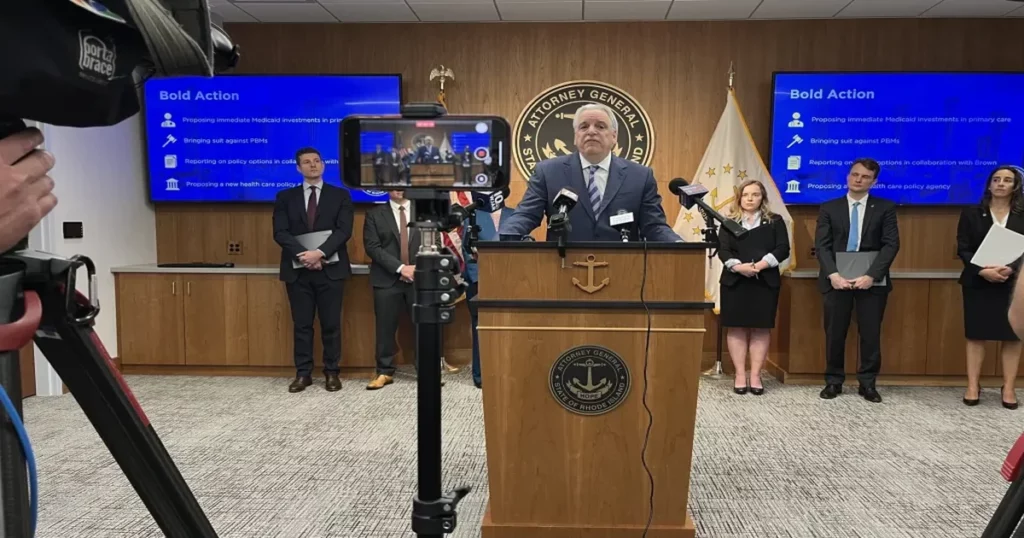
Twenty-four states and D.C. have filed a federal lawsuit accusing the Trump administration of unlawfully withholding billions in K-12 education funding, disrupting vital programs nationwide.
A coalition of 24 states and the District of Columbia has taken legal action against President Donald Trump’s administration, alleging that it unlawfully withheld $6.8 billion in federal education funds designated for K-12 programs. The lawsuit, filed Monday in a federal court in Providence, Rhode Island, marks a new front in a growing conflict between the White House and Democratic-led states over the control and allocation of education resources.
The plaintiffs claim that the U.S. Department of Education, in coordination with the Office of Management and Budget (OMB), froze funding for six congressionally approved programs without proper legal justification. According to the complaint, the funding helt was not only abrupt but also unconstitutional, bypassing Congress’ exclusive authority over federal spending.
See Also : China Expands Global Influence.
The lawsuit centers on programs that support some of the country’s most vulnerable student populations. The funding freeze impacts initiatives for migrant framworker children, teacher recruitment and training, English language learners, academic enrichment, and after-school and summer programming. Additionally, fund for adult literacy and job- readiness initiatives were also withheld.
State leaders argue that the Trump administration was obligated by law to distribute the funds by July 1, but on June 30, just one day prior, the Department of Education notified States it would not be releasing the gran awards. The reason cited was a transition-related policy review, sparking immediate backlash from education officials across the country.
In a statement released at the time, a spokesperson for OMB said the decision came after preliminary findings suggested that the grants had been used to “subsidize a radical leftwing agenda.” The administration objected in particular to the use of federal education funds to support scholarships for undocumented students and curriculum content involving LGBTQ themes.
State attorneys general responded swiftly, accusing the federal government of weaponizing the budget process to impose ideological control over public education. They claim that the administration’s refusal to release the funds violates both the Constitution’s separation of powers and the Impoundment Control Act, which requires the executive branch to follow specific producers if it intends to delay or cancel appropriated spending.
“This administration has overstepped its authority and put millions of students at risk,” said New York Attorney General Letita James, one of the lead plaintiffs in the case. “These are not discretionary funds. These are dollars that Congress allocated to support educational equity and opportunity across the nation.”
The ripple effects of the freeze are already being felt, plaintiffs say. In many districts, after-school and summer learning programs have been canceled or severely curtailed. Other initiatives, such as those aimed at boosting English proficiency among immigrant students, have been halted mid-implementation, leaving schools scrambling to reconfigure their budgets and staffing.
Rhode Island Governor Dan McKee, whose state is hosting the lawsuit, emphasized the chaos by the decision. “This is not just a budgetary issue, it’s a direct assault on the services our children and families rely on,” he said. “We’re standing up for our schools and demanding that the federal government do what the law requires.”
The suit also highlights concerns about broader federal overreach. By unilaterally halting congressionally mandated funding, the administration risks setting a precedent that could undermine legislative control over national spending priorities.
Legal experts suggest the plaintiffs have strong case. “The Impoundment Control Act was specifically designed to prevent exactly this kind of executive interference,” said constitutional law professor Maya Richards of Georgetown University. “The courts have consistently upheld Congress’ power of the purse, and I expect they’ll take this case very seriously.”
For its part, the Trump administration has defended its actions as part of its broader effort to align federal programs with the president’s “America First” agenda. Officialssay the review of educational grants is necessary to root out what they view as misuse or ideological bias in federally funded programs.
In the meantime, educators, parents, and advocacy groups continue to voice concern. “This funding is not political, it’s essential,” said Carla Nunez,a public teacher in New Mexico. “Without it, we’re abandoning some of our most at-risk students.”
The lawsuit represents only the latest in a string of legal challenges aimed at the Trump administration’s efforts to reshape federal education policy. But given the scale of the funds in question and the wide-reaching impact, this may prove to be the most consequential yet.
A preliminary hearing is expected within the next few weeks. If the court rules in favor of the states, the administration may be forced to release the frozen funds immediately. Unitl then, school systems across the country are left in limbo, uncretain if, and when critical educational programs will be restored.


