President Trump announced plans Wednesday to impose sweeping 100% tariffs on imported semiconductors while offering exemptions for companies that invest in U.S. production facilities. The proposed measure represents an aggressive attempt to reshore electronics supply chains, though national security experts warn it may not sufficiently reduce reliance on Taiwanese chip manufacturing.
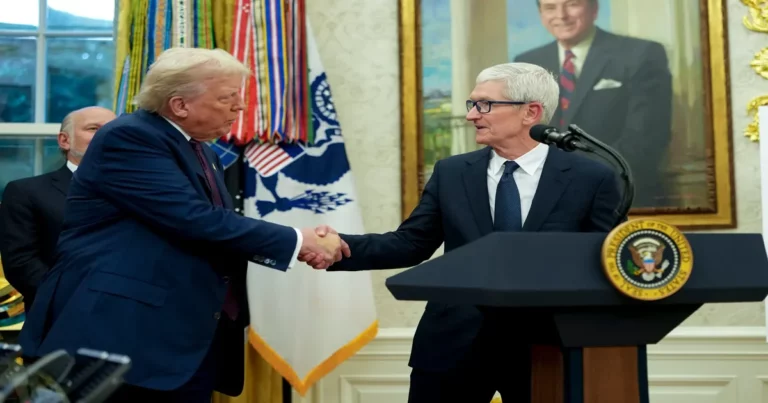
Speaking at a White House event where Apple CEO Tim Cook announced a $100 billion U.S. investment, Trump outlined his vision for the semiconductor tariffs. “If you’re building, there will be no charge,” the president said, adding that companies failing to meet investment commitments would face substantial fines. The policy, which could take effect next week, follows a Section 232 national security investigation into semiconductor supply chains.
Major chip manufacturers including Nvidia, Taiwan Semiconductor Manufacturing Company (TSMC), and Micron appear positioned to qualify for exemptions due to recent U.S. expansion announcements. TSMC is currently building two fabrication plants in Arizona totaling $40 billion in investments, while Intel has committed $20 billion for new Ohio facilities.
The tariff proposal marks a sharp departure from Biden-era semiconductor policies that emphasized direct subsidies through the CHIPS Act. Trump administration officials have criticized those grants as wasteful, arguing tariffs provide stronger market incentives. “We’re replacing handouts with fair trade,” Commerce Secretary Wilbur Ross told reporters following the announcement.
While the exemptions could protect consumers from immediate price spikes on electronics, national security analysts express concern that the policy fails to address U.S. dependence on advanced chips from Taiwan. The self-governing island produces approximately 90% of the world’s most sophisticated semiconductors while facing persistent military threats from China.
The semiconductor announcement coincided with renewed attention on the Trump administration from “South Park,” which dedicated its second consecutive episode to satirizing White House officials. The Comedy Central program featured Homeland Security Secretary Kristi Noem shooting small dogs, referencing her controversial admission about euthanizing a family pet.
Industry groups offered mixed reactions to the tariff plan. The Semiconductor Industry Association warned of potential supply chain disruptions, while the National Association of Manufacturers praised the focus on domestic production. Some economists noted the policy could accelerate existing reshoring trends but cautioned about possible retaliatory measures from trading partners.
Administration officials said the Commerce Department would finalize tariff rules by month’s end, with provisions to regularly review companies’ compliance with their investment pledges. The measure represents Trump’s latest use of Section 232 authority, following similar tariffs on steel, aluminum, and automotive imports during his first term.


