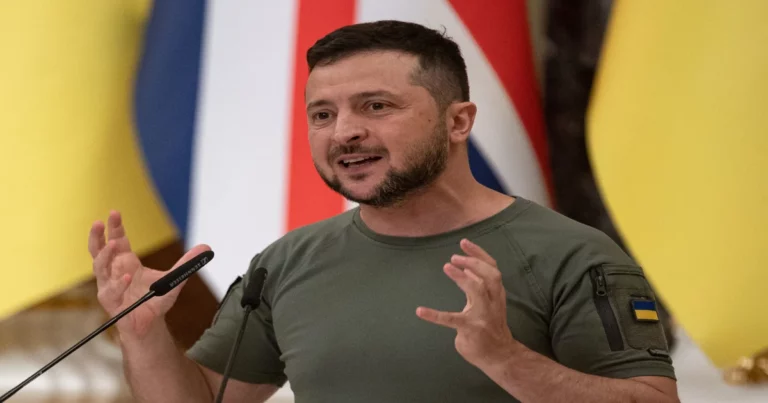
Ukrainian President Volodymyr Zelenskiy secured support from European leaders and NATO on Sunday before a planned Russia-U.S. summit that Kyiv fears could see Presidents Vladimir Putin and Donald Trump attempt to set terms for ending the 3½-year war without Ukraine’s involvement. Trump, who had recently threatened further sanctions on Russia, announced Friday he will meet Putin on August 15 in Alaska.
A White House official said Trump is open to Zelenskiy attending, but preparations are underway for a bilateral meeting. On Sunday, Ukraine’s foreign affairs ministry reported at least 12 people injured in Russian strikes on the Zaporizhzhia region. Zelenskiy responded, saying, “That is why sanctions are needed, pressure is needed.”
Putin has ruled out meeting Zelenskiy, calling conditions for such talks “unfortunately still far” from being met. Trump suggested any deal might include “some swapping of territories to the betterment of both (sides),” heightening Kyiv’s concerns it could be pressured to cede land. Zelenskiy said decisions made without Ukraine would be “stillborn” and unworkable.
On Saturday, the leaders of Britain, France, Germany, Italy, Poland, Finland, and the European Commission said any diplomatic outcome must safeguard the security of both Ukraine and Europe. EU foreign policy chief Kaja Kallas stated, “Any deal between the U.S. and Russia must have Ukraine and the EU included, for it is a matter of Ukraine’s and the whole of Europe’s security,” adding that EU foreign ministers will meet Monday to discuss next steps.
NATO Secretary General Mark Rutte told ABC News the summit would test Putin’s seriousness about ending the war, stressing the need for Ukraine to decide its own future as a sovereign nation. Rutte said no agreement should legally recognize Russian control over Ukrainian territory, though it might involve de facto recognition similar to U.S. policy toward the Baltic states after World War Two.
A European official said the EU has prepared a counter-proposal to Trump’s plan but gave no details. Former Russian president Dmitry Medvedev accused Europe of trying to block U.S. efforts to resolve the conflict, while Russian Foreign Ministry spokeswoman Maria Zakharova likened Ukraine-EU relations to “necrophilia.” Russian war blogger Roman Alekhin said Europe risked being reduced to a spectator if Putin and Trump struck a direct deal.
Russia currently controls Crimea, claimed in 2014, and has annexed Luhansk, Donetsk, Kherson, and Zaporizhzhia, though it holds only about 70% of the last three. It also controls smaller areas in other regions, while Ukraine holds a small part of Russia’s Kursk region. Pro-Kremlin analyst Sergei Markov speculated a land swap could give Ukraine 1,500 square kilometers and Russia 7,000, claiming Russia would take the latter within six months.
Western military analysts say Russia captured about 500 square kilometers in July, with high casualties. European and Ukrainian officials fear Trump might align with Putin for a deal favorable to Moscow, possibly linked to joint U.S.-Russia business ventures. Although Trump recently criticized Putin amid intensified Russian airstrikes, the planned summit has renewed fears of Ukraine being sidelined.
Phillips P. O’Brien, professor of strategic studies at the University of St Andrews, wrote that any deal from Alaska could be disastrous for Ukraine and Europe, forcing Kyiv to choose between accepting “a humiliating and destructive deal” or continuing the war with uncertain European support. Ukrainian analyst Volodymyr Fesenko said a united front with Europe is Ukraine’s primary asset in resisting exclusion from talks.
U.S. Vice President JD Vance told Fox News that any settlement would likely leave both Russia and Ukraine dissatisfied, stating, “Both the Russians and the Ukrainians, probably, at the end of the day, are going to be unhappy with it.”


