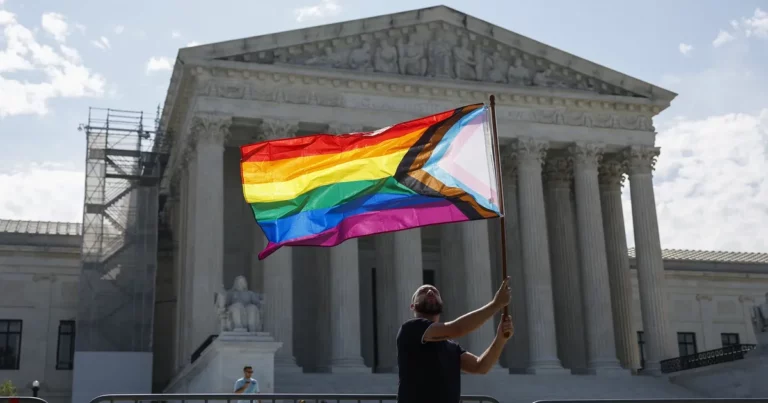
LGBTQ+ advocates say the Supreme Court is unlikely to take a case challenging marriage equality, even though it is the first such challenge since the high court recognized the right a decade ago.
Legal experts believe the court is not expected to hear the case, noting that reversing protections for same-sex marriage after so many years would be highly complex. The petition challenges the 2015 Obergefell v. Hodges decision, which found marriage equality to be protected under the 14th Amendment’s due process and Equal Protection clauses.
Former Kentucky county clerk Kim Davis is asking the court to overturn an order requiring her to pay $360,000 to a gay couple in damages and fees for refusing them a marriage license in 2015. Davis has fought the ruling for years, with lower courts repeatedly rejecting her appeals. In a statement announcing the petition, her attorney called Obergefell an “egregious opinion” that violated his clients’ “religious liberty.”
Mary Bonauto, one of the attorneys for lead plaintiff Jim Obergefell, told Axios the case is “extremely narrow” and said Davis is “attempting to shoehorn an opportunity to relitigate” the landmark ruling. “There’s good reason for the Supreme Court to deny review in this case rather than unsettle something so positive for couples, children, families and the larger society as marriage equality,” Bonauto said.
Shannon Minter, spokesperson for the National Center for LGBTQ Rights, told Axios the court has shown “an alarming willingness” to reverse long-standing precedent. He cited the Dobbs decision reversing Roe v. Wade, rulings that weakened the Voting Rights Act and affirmative action, and a decision limiting lower courts’ ability to block nationwide policies through universal injunctions, referencing a case related to President Trump’s attempt to end birthright citizenship.
Justice Clarence Thomas stated in 2022 that the court should reconsider rulings protecting same-sex relationships, marriage equality, and access to contraception.
Experts say reversing Obergefell could result in marriages being valid in some states but not in others, creating major issues with taxes, insurance, and child custody. Attorney Robbie Kaplan, whose 2013 Supreme Court arguments helped lay the groundwork for Obergefell, told Axios, “It’s hard to imagine a situation where the reliance interests are more consequential than in the case of nationwide marriage equality.” She added that it would cause “an almost indescribable amount of (needless) suffering and heartache.”
In 1996, Congress passed the Defense of Marriage Act, defining marriage federally as between one man and one woman. At that time, 68% of Americans opposed same-sex marriage, according to Gallup. Now, ten years after Obergefell, 68% support it, Gallup reports.
The Respect for Marriage Act, passed in 2022, codified rights to same-sex and interracial marriage and repealed the Defense of Marriage Act. However, it does not prevent states from limiting or banning same-sex marriage if Obergefell were overturned.
The Supreme Court will decide this fall whether to hear Davis’ case. The court receives between 7,000 and 8,000 petitions annually but hears arguments in about 80 cases, according to its website.
“None of us can predict what the court will do,” Suzanne Goldberg, Director of the Sexuality and Gender Law Clinic at Columbia Law, told Axios. “But she’s not entitled to Supreme Court review. And there is nothing here to suggest the Supreme Court should take this case.”


