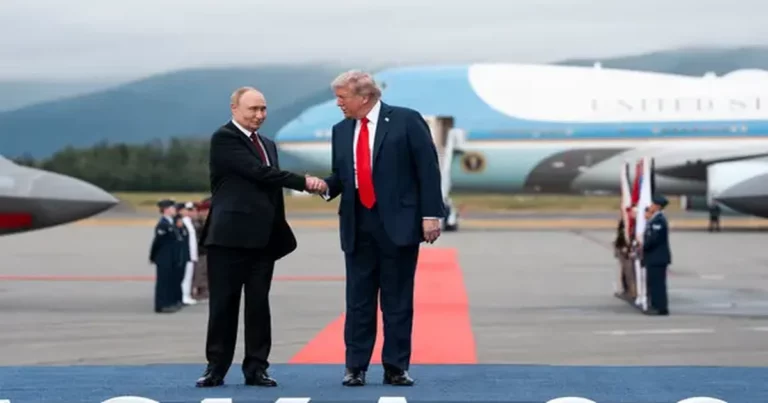
President Trump has shifted course on Ukraine after meeting President Vladimir V. Putin of Russia, endorsing a peace plan requiring Ukraine to give up territory instead of pursuing the cease-fire he previously demanded.
Trump’s decision breaks from commitments made with President Volodymyr Zelensky of Ukraine and European allies before the U.S.-Russia summit in Alaska. Talks are set to continue Monday when Zelensky visits Trump at the White House.
Two senior European officials said Trump told allied leaders that peace could come quickly if Zelensky surrendered the remainder of the Donbas region, even areas not yet under Russian control. In exchange, Putin promised a cease-fire at current battle lines and a pledge not to attack Ukraine or Europe again, despite past violations of similar commitments.
Before the meeting, Trump threatened sanctions if Putin refused a deal, but those threats have been suspended. European leaders expressed concern, recalling Trump’s previous reversals after speaking with Putin.
On Truth Social, Trump wrote that after calls with Zelensky and European leaders, “it was determined by all” that moving directly to peace negotiations was better than implementing a cease-fire first. European governments quickly contradicted that claim, stating they had not agreed. Britain, France, Germany and others pledged to intensify sanctions “as long as the killing in Ukraine continues.”
Zelensky, excluded from the Alaska summit, confirmed he would meet Trump Monday to “discuss all of the details regarding ending the killing and the war.” Ukrainian officials remain uncertain why Trump dropped the cease-fire condition.
Prime Minister Mark Carney of Canada cautiously praised Trump for creating “the opportunity to end Russia’s illegal war in Ukraine” while affirming Canada’s support for Kyiv. European leaders announced a Sunday virtual meeting to align on next steps.
Putin, speaking after the summit, repeated that resolving Ukraine’s crisis required addressing “root causes,” a phrase he uses to reference Russia’s opposition to NATO expansion and demand for influence over Kyiv’s future. In the past, he has tied peace to Ukraine renouncing NATO, withdrawing from regions Russia claims, and the West lifting sanctions.
Baltic and Nordic nations, including Finland and Sweden, issued a sharper statement Saturday declaring they would continue arming Ukraine and rejecting Russian demands. “Putin cannot be trusted,” they wrote, stressing Ukraine’s sovereignty and right to join NATO and the EU.
The Alaska summit drew comparisons to historic appeasement. Former Prime Minister Boris Johnson called it “the most vomit-inducing episode in international diplomacy.” Critics, including former NATO ambassador Ivo Daalder, said Putin manipulated Trump again.
Trump nonetheless praised the meeting as “a great and very successful day.” Senator Lindsey Graham expressed optimism, saying he had never been more hopeful for an “honorable and just” end to the war.
Still, Trump’s reversal leaves Putin free to wage war while talks unfold. Ukrainian lawmakers voiced alarm, with one warning that “Putin and Trump are starting to force us into surrender.” Zelensky has not ruled out territorial compromises but insists any deal must include firm security guarantees.
European leaders reiterated support for Ukraine, avoided contradicting Trump directly, and stressed continued sanctions. Prime Minister Keir Starmer of Britain and President Emmanuel Macron of France both backed robust security guarantees for Kyiv but emphasized the need to keep pressure on Moscow.
Italian Prime Minister Giorgia Meloni said Trump endorsed an Italian plan for collective security guarantees short of NATO membership. Zelensky welcomed trilateral talks with Trump and Putin, but Putin has so far refused to meet him directly.
Meanwhile, Russia maintains battlefield momentum. Recent breakthroughs in Donbas underscored Ukraine’s strained defenses and troop shortages. Russia now controls nearly a fifth of Ukraine’s territory, gained through steady advances since 2022, despite suffering heavy casualties.
Vice President JD Vance confirmed the U.S. would stop funding Ukraine’s defense directly, though Kyiv has secured $1.5 billion in European funds to buy American weapons. Analysts warn Russia’s advantage, combined with Trump’s alignment with Putin’s plan, reshapes the negotiating landscape.
Back in Washington, Trump reiterated his preference for a peace deal over a cease-fire. Zelensky said he would push for clarity and insisted “the killings must stop as soon as possible.” For now, Russian drone and missile strikes continue across Ukraine.


