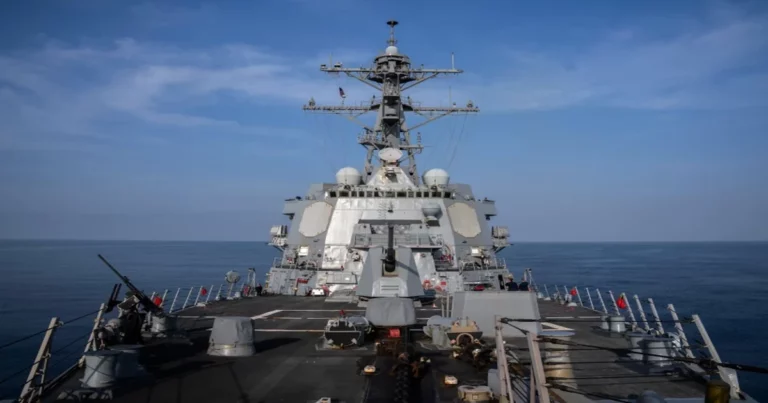
US destroyers are heading to waters off Venezuela as President Donald Trump intensifies efforts to confront Latin American drug cartels, according to a US official briefed on the plan.
The USS Gravely, USS Jason Dunham, and USS Sampson are expected to arrive in the region soon, the official said Tuesday on the condition of anonymity. A Defense Department official confirmed the assets were assigned in support of counternarcotics efforts, noting the deployment would last “over the course of several months.”
The move comes as Trump has pressed for expanded use of the military to disrupt cartels he blames for fentanyl and other drugs entering American communities and fueling violence in US cities. He has urged Mexican President Claudia Sheinbaum to take tougher action than her predecessor against cartels, but she has rejected any suggestion of US military intervention, citing Mexico’s sovereignty.
In February, Trump designated Venezuela’s Tren de Aragua, MS-13 in El Salvador, and six Mexican-based groups as foreign terrorist organizations. His administration has also intensified immigration enforcement targeting alleged gang members.
The designation, usually applied to groups like al-Qaida or the Islamic State, is rarely used for criminal cartels focused on money. But Trump officials argue the groups’ cross-border drug trafficking, migrant smuggling, and violent expansion justify the label.
Earlier this month, Trump’s administration doubled its reward for the capture of Venezuelan President Nicolás Maduro to $50 million, accusing him of being among the world’s largest narco-traffickers and of collaborating with cartels to send fentanyl-laced cocaine to the US.
Venezuela’s government press office did not respond to a request for comment from the Associated Press. However, Foreign Minister Yvan Gil issued a statement Tuesday criticizing the US position. “Washington’s accusing Venezuela of drug trafficking reveals its lack of credibility and the failure of its policies in the region,” Gil said. “While Washington threatens, Venezuela steadily advances in peace and sovereignty, demonstrating that true effectiveness against crime is achieved by respecting the independence of its peoples. Every aggressive statement confirms the inability of imperialism to subdue a free and sovereign people.”
Following the statement, Venezuela announced a temporary ban on the purchase, sale, and operation of drones in its airspace. In 2018, drones armed with explosives detonated near Maduro during a speech broadcast live to soldiers in Caracas.
On Monday, Maduro said the US had escalated its threats against Venezuela and announced plans to mobilize more than 4.5 million militia members nationwide. The militias, created by former President Hugo Chávez, incorporate civilian volunteers to support the armed forces against external and internal threats.
“The empire has gone mad and has renewed its threats to Venezuela’s peace and tranquility,” Maduro said at an event in Caracas, without referencing specific US actions.
Maduro was indicted in New York federal court in 2020, during Trump’s first term, on charges of narco-terrorism and conspiracy to import cocaine. At that time, the US offered a $15 million reward for his arrest.


