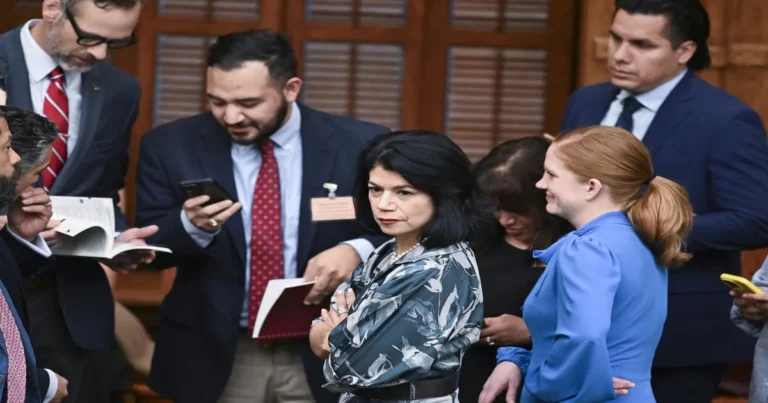
The Texas Senate early Saturday approved a new congressional map designed to expand Republican representation, sending the plan to Governor Greg Abbott after weeks of partisan fighting.
Republican lawmakers advanced the map despite strong Democratic opposition, setting off a national redistricting battle from Albany to Sacramento and positioning the GOP to gain up to five additional seats in Texas.
The Senate approved the new lines on an 18-11 party-line vote shortly after 12:30 a.m. Saturday, following more than eight hours of debate.
Senator Carol Alvarado, D-Houston, had planned to filibuster into Saturday, but Senate Republicans used a rare procedural motion just after midnight to end debate and force a final vote. Some observers in the gallery shouted “shame” and “fascist” after the decision and were removed.
The map, sought by President Donald Trump to strengthen the GOP’s U.S. House majority in next year’s midterms, adds up to five Republican seats by dismantling Democratic strongholds in Austin, Dallas, and Houston, while making two South Texas seats more favorable to Republicans. It also secures all 25 districts already held by Republicans.
Senator Phil King, R-Weatherford, who sponsored House Bill 4, said the plan “meets the critically important goals of legality, of political performance for Republicans and of improved compactness.” He maintained that racial population data was not considered in drawing the map.
Supporters argued the new seats are vital to preserving the GOP’s slim majority in Congress, which could otherwise shift to Democrats. King said failure to pass the map would risk Republican control and lead to “nothing but inquisitions and impeachments and humiliation for our country.”
Although redistricting typically follows the census every 10 years, Republicans said it was legal to redraw lines mid-decade for partisan advantage. They pointed to blue-state gerrymandering efforts to justify the move.
The U.S. Supreme Court ruled in 2019 that partisan gerrymandering is allowed, but the Voting Rights Act prohibits maps that reduce voting power based on race. Democrats argued the Texas plan violated those protections and suppressed the influence of Black and Latino voters.
“Today, the majority will prevail, but the rights of minorities were ignored, outnumbered, outvoted and outgunned,” said Sen. Judith Zaffirini, D-Laredo. She added that Democrats used every available tool in opposition but were ultimately overpowered.
California Gov. Gavin Newsom has responded by proposing a map that could create five new Democratic seats, offsetting Texas gains. Other states, including Florida, Indiana, Missouri, and Ohio, are also considering mid-decade redistricting.
Alvarado, with other Democrats, had prepared to filibuster on Friday, even arranging to read more than 12 hours of constituent testimony. But Republicans cut debate short after citing a campaign email Alvarado sent promoting the effort, calling it a violation of Senate decorum. Democrats denounced the move as an excuse to silence debate.
The state House approved the map Wednesday after its own marathon debate. Earlier, more than 50 House Democrats fled the state for two weeks to deny a quorum, temporarily halting the process.
Republicans responded by issuing civil arrest warrants, seeking extradition from Illinois, and threatening to vacate Democratic seats. After Democrats returned, Speaker Dustin Burrows required lawmakers to agree to police escorts if they left the Capitol. Rep. Nicole Collier, D-Fort Worth, refused and stayed inside the building for 54 hours, drawing national attention.
Democrats said their actions helped launch a broader movement against partisan gerrymandering and vowed to continue the fight in court. “This fight is far from over,” Rep. Gene Wu of Houston said after the House vote. “Our best shot is in the courts. This part of the fight is over, but it is merely the first chapter.”


