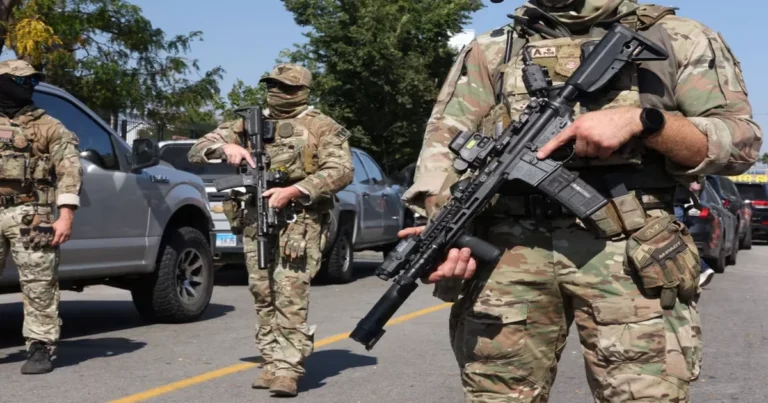
The state of Illinois and the city of Chicago have sued the Trump administration over its decision to deploy National Guard troops to the city, calling the move unconstitutional and politically driven.
The lawsuit, filed Monday in U.S. District Court for the Northern District of Illinois, seeks an injunction to halt what officials described as the “illegal and dangerous federalization” of both the Illinois and Texas National Guard. It also challenges the president’s broader authority to federalize Guard units without a state’s consent.
The legal action comes just hours after a federal judge in Oregon blocked a similar deployment of National Guard troops to Portland, marking another blow to President Donald Trump’s escalating campaign to deploy military forces in Democratic-led cities amid growing protests against federal immigration enforcement.
“Defendants’ deployment of federalized troops to Illinois is patently unlawful,” the complaint reads. “Plaintiffs ask this court to halt the unconstitutional federalization of National Guard members across the United States.”
Illinois Pushes Back Against White House Orders
The lawsuit was filed two days after the White House announced that Trump had authorized 300 Illinois National Guard troops to be deployed to Chicago, claiming the move was necessary to protect federal officers and property.
The plan quickly drew condemnation from Governor JB Pritzker, who refused the administration’s request to activate the Guard.
“The president demanded I call up Illinois soldiers to enforce his political agenda,” Pritzker said Sunday. “When I refused, he decided to go around me. That’s not law and order — that’s an invasion.”
According to the complaint, the administration also intends to send 400 Texas National Guard members to Illinois and Oregon to reinforce federal facilities. The filing claims that Trump’s action is motivated by politics, not public safety, and that his rhetoric toward Chicago has long been “threatening and derogatory.”
The lawsuit cites a September 6 social media post in which Trump warned that Chicago would soon “find out why it’s called the Department of WAR,” a reference to his controversial rebranding of the Pentagon.
White House Defends the Move
The White House dismissed the lawsuit as obstructionist, insisting the president was acting within his authority to protect federal property.
“President Trump will not turn a blind eye to the lawlessness plaguing American cities,” spokesperson Abigail Jackson said in a statement. “Amid ongoing riots that local leaders have failed to stop, the president has exercised his lawful power to safeguard federal officers and assets.”
Administration officials have repeatedly framed the deployments as a response to “violent unrest” outside Immigration and Customs Enforcement (ICE) facilities. But state officials argue the protests have been largely peaceful, calling the White House narrative “a flimsy pretext.”
Legal Grounds and Key Arguments
Illinois and Chicago are asking the court to declare the deployment unconstitutional, arguing it violates both the Posse Comitatus Act — which restricts the use of federal troops for domestic law enforcement — and the state’s sovereign right to control its own Guard units.
“There is no legal or factual justification for this action,” the complaint states. “Defendants’ provocative actions threaten to destabilize public order by inciting unrest.”
Officials noted that protests in Broadview, a suburb west of Chicago where an ICE facility has become a rallying point, have been “limited in scale and nonviolent.” Instead of restoring order, the lawsuit claims, the deployment of troops “has heightened tensions and diverted local law enforcement resources.”
Broader Legal Fallout Nationwide
The Illinois case mirrors the legal battle unfolding in Oregon. On Sunday, a Trump-appointed judge in Portland temporarily blocked the president’s plan to federalize National Guard troops from any U.S. state for deployment to Oregon, ruling that the protests there did not rise to the level of a “rebellion” or justify military involvement.
“The president appears to have exceeded his constitutional authority,” that ruling said, emphasizing that the demonstrations posed no genuine danger to national stability.
Legal experts say the Illinois challenge could determine how far a president can go in bypassing governors to mobilize National Guard units.
“This is about federalism,” said Professor Emily Berman, a constitutional scholar at the University of Houston. “If the courts side with Illinois, it could set a nationwide precedent limiting federal control over the Guard.”
Political Context and Escalating Tensions
Trump’s decision to send troops to Chicago marks another flashpoint in his ongoing feud with Democratic-led cities. The administration has previously sent federal agents and military support to Los Angeles, Washington D.C., and Portland, often over the objections of local officials.
Governor Pritzker and Chicago Mayor Brandon Johnson both accused the White House of exploiting the issue for political gain, arguing that Trump’s repeated portrayal of Chicago as “a failed city” has no factual basis.
“Chicago doesn’t need an occupying army,” Mayor Johnson said in a statement. “We need federal investment in jobs, housing, and safety — not soldiers.”
The lawsuit adds that Illinois and Chicago have already seen a “surge” in federal agents around ICE facilities, which has sparked unrest and confusion.
“By flooding our city with federal forces, the administration is escalating tension, not solving it,” the filing states.
Next Steps
The Justice Department has not yet filed a response, but White House officials have vowed to fight the case in court.
Legal analysts predict that the Illinois suit, along with the Oregon case, could reach the Supreme Court if conflicting rulings emerge across jurisdictions.
“These lawsuits are testing the boundaries of executive power in domestic affairs,” said Dr. Robert Kagan, a former DOJ attorney. “If the courts uphold Trump’s authority, it could dramatically expand presidential power in future crises.”
For now, Illinois officials say they will continue to resist what they describe as “federal overreach.”
“The president is not a king,” Pritzker said. “He cannot commandeer our state forces for his own agenda. We’ll fight this in every court we have to.”


