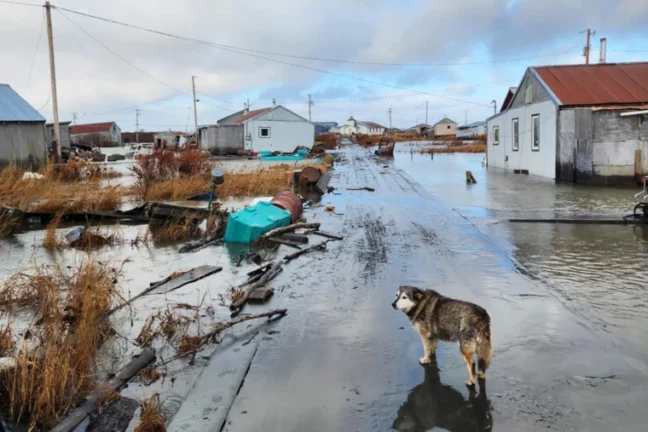
Western Alaska is reeling after the remnants of Typhoon Halong unleashed catastrophic flooding that wiped out two coastal villages, killed at least one person, and displaced more than 1,400 residents.
The storm, one of the most destructive weather events to hit the region in years, battered the Yukon-Kuskokwim Delta with hurricane-force winds and massive surf over the weekend. The hardest-hit communities — Kipnuk and Kwigillingok — suffered near-total destruction, with entire homes torn from their foundations and swept away by floodwaters.
Officials from the Alaska Division of Homeland Security and Emergency Management confirmed that dozens of homes in multiple communities were inundated, and widespread infrastructure damage was reported across the delta.
In Kipnuk, resident Brea Paul described an apocalyptic scene as the waters rose rapidly.
“We saw about 20 homes floating in the water,” Paul told The Associated Press. “Some houses blinked their phone lights at us like they were asking for help, but we couldn’t do anything.”
Authorities identified the victim as 67-year-old Ella Mae Kashatok of Kwigillingok. Two more residents remain missing, though the Alaska State Troopers said late Tuesday that search-and-rescue operations had ended.
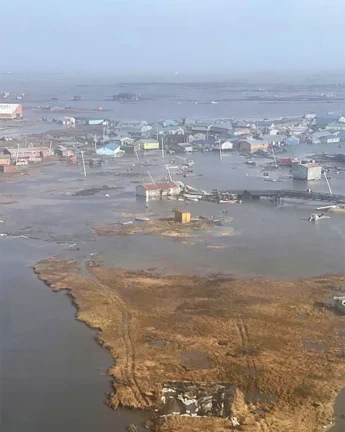
Search teams, supported by the U.S. Coast Guard, Alaska Army National Guard, and Alaska Air National Guard, covered more than 67 square nautical miles using aircraft, drones, and boats before transitioning efforts into a recovery phase.
Photographs and video from the scene showed entire sections of coastline ripped apart, with only splintered remains of wooden homes left standing. In Tuntutuliak, part of the Bethel Census Area, floodwaters reached several feet high, forcing residents to evacuate to higher ground.
Military and rescue officials said that over 30 people stranded in remote areas were rescued by the Coast Guard and the National Guard during the operation.
The U.S. Northern Command and Alaska emergency officials said their current focus is on humanitarian support.
“Along with sheltering, we are coordinating food, water, and emergency supplies to meet essential needs,” the agency said Tuesday on Facebook.
They added that federal and state relief teams are being deployed to provide temporary housing and rebuild critical infrastructure.
“To those who have been displaced or have lost homes — you are not alone,” the agency wrote. “We will not stop working until every community has the support and resources needed to begin recovery.”
Meteorologists said the destruction was amplified by a rare convergence of warm Pacific air and a strong Arctic cold front, which intensified Halong’s remnants as they moved across the Bering Sea. The resulting storm surge flooded dozens of low-lying coastal villages.
Officials say the total number of damaged or destroyed homes could rise as crews reach more remote communities in the coming days.
In the aftermath, Alaska faces the daunting task of rebuilding communities where roads are limited, supplies must be flown in, and temperatures are already dropping as winter approaches.
State and federal officials have not yet released an estimate of the economic cost, but early assessments suggest it could exceed tens of millions of dollars in property loss and infrastructure damage.
The Federal Emergency Management Agency (FEMA) said it is coordinating with Alaska’s emergency management office and tribal authorities to determine immediate and long-term needs.
As cleanup begins, residents across western Alaska are grappling with what comes next. Many have been relocated to shelters while others stay with relatives in nearby villages.
“This storm has changed everything for our community,” Paul said. “We’ve lost homes, memories, and our sense of safety — but we’re still alive, and that’s what matters.”


