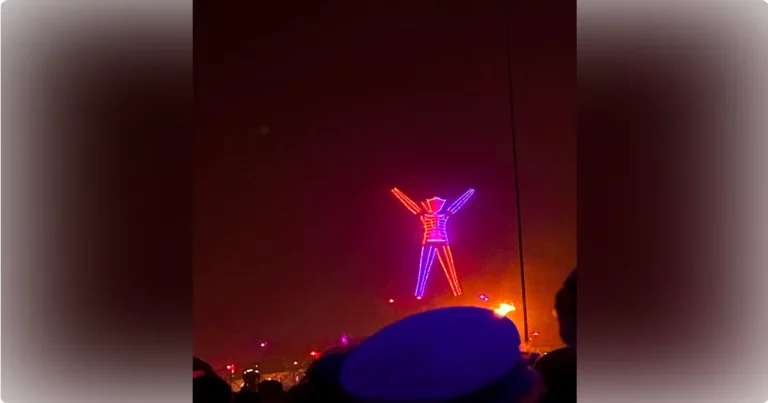
A Burning Man death is under investigation as a homicide after a man was discovered lying in a pool of blood during preparations for the annual festival’s climactic burn. Authorities said the discovery occurred on Aug. 30 when tens of thousands of attendees were readying to watch the 100‑foot‑tall wooden effigy known as the Man go up in flames.
Deputies from the Pershing County Sheriff’s Office found the body at about 9:14 p.m. after a festivalgoer flagged down a deputy to report a person “lying in a pool of blood”. The sheriff’s office said its deputies and Bureau of Land Management rangers responded immediately and located a single white adult male on the ground who was “obviously deceased”.
Investigators have not released the man’s identity or any details about how he died. Officials described the incident as a “singular crime” but urged all participants to be vigilant about their surroundings. They said the portion of the temporary desert city where the body was discovered will remain cordoned off with a heavy law‑enforcement presence until the scene is released. The Washoe County Sheriff’s Office is assisting with the investigation.
In a statement, Burning Man organizers asked those still on the playa not to interfere with law enforcement and reminded attendees that “the safety and well‑being of our community are paramount”. The annual event attracts tens of thousands of “Burners” to a remote desert area northeast of Reno for a weeklong celebration of art, music and self‑expression. Participants build an entire city from scratch and dismantle it when the festival ends, culminating with the two large‑scale burns of the Man and the Temple.
The harsh environment of the Black Rock Desert adds to the challenge. Dust storms, slick mud and long traffic jams are common on the playa, and organizers repeatedly urge attendees to come prepared and respect safety protocols. Even with those precautions, medical emergencies and other incidents occur each year as people test their limits in extreme heat and dusty conditions on the open playa.
Though authorities believe the latest death is the first homicide at the event, several fatalities have been recorded at or near Burning Man since the festival moved to the Black Rock Desert in 1990. Those incidents include accidents, suicides and medical emergencies.
In 1996, San Francisco neon artist Michael Fury was killed hours before the festival began when his motorcycle collided with a van driven by an acquaintance just outside the gates. Contemporary accounts said he was riding without headlights and may have been intoxicated.
Seven years later, in 2003, Katherine Lampman of San Mateo, California, died when she tried to step off a moving “art car” and was run over by a trailing vehicle at Burning Man; investigators ruled the fatality an accident. Later the same day, pilot Barry Jacobs of San Rafael, California, was critically injured when his small Beechcraft BE‑35 airplane crashed while attempting to land at the festival’s temporary airstrip. Jacobs later died of his injuries.
Another tragedy struck in 2007 when Jermaine “Jerm” Barley, a 22‑year‑old DJ known as Optic Orange, died by suicide inside his tent at Burning Man. According to Pershing County Sheriff Ron Skinner, Barley had been distraught, but his relatives did not believe he would harm himself.
The most widely known death at the festival occurred in 2014. Alicia Louise Cipicchio, a 29‑year‑old manager of an art gallery in Jackson, Wyoming, was killed after she was struck by an art car. She had studied art at the University of North Carolina at Greensboro and was remembered as someone who loved the outdoors and life.
In 2018 a 41‑year‑old man named Aaron Joel Mitchell died after breaching a safety perimeter and running into the Burning Man structure fire on Saturday night. He was pulled from the flames, airlifted to the University of California Davis Burn Center and pronounced dead at 6:28 a.m. the next da.
More recently, in 2023, Leon Reece of Truckee, California, was found unresponsive on the playa and given CPR. The Washoe County Regional Medical Examiner’s Office said drug intoxication was suspected in his death.
The following year another tragedy unfolded. On the first day of the 2024 event, 39‑year‑old Kendra Frazer was found unresponsive in her camp. She died in her sleep of an asthma attack, her longtime partner said, and the Washoe County medical examiner later confirmed the cause.
The homicides, accidents and medical emergencies that have punctuated Burning Man’s history underscore the challenges of hosting a temporary city in a remote, harsh environment. Even as the latest investigation continues, organizers remind participants to look after one another and respect the law‑enforcement presence on the playa, hoping to ensure that the festival’s creative energy is not dimmed by tragedy


