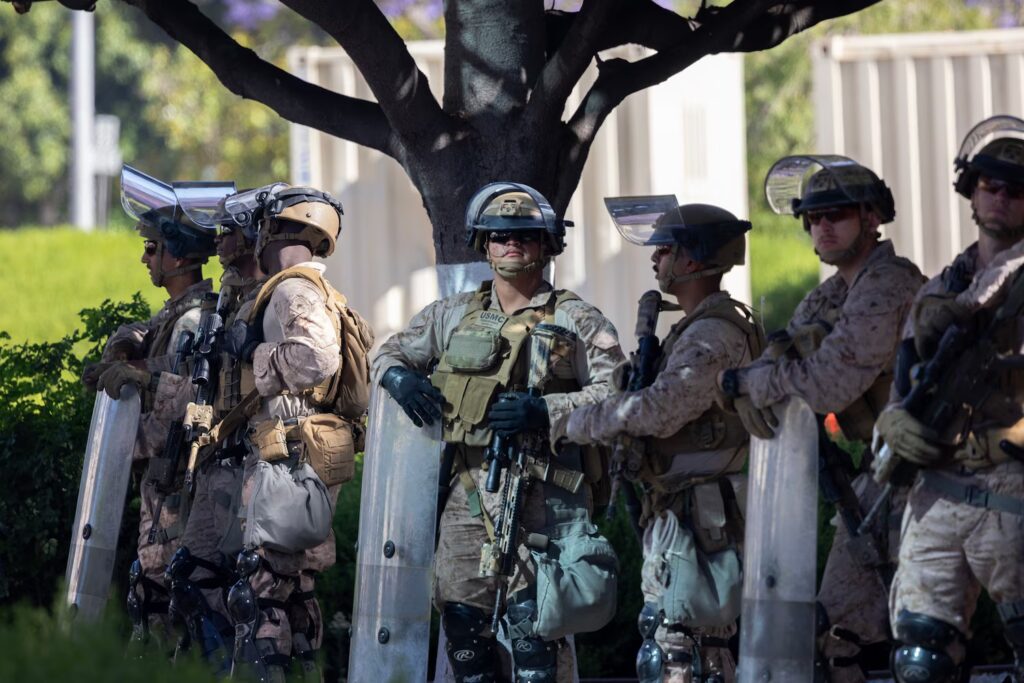
In a bold new move to tighten immigration enforcement, the Trump administration is sending 200 active-duty Marines to Florida to assist Immigration and Customs Enforcement (ICE) officers with operations targeting undocumented immigrants.
Marines Join ICE in Deportation Operations
The deployment, confirmed by U.S. Northern Command on Thursday, is part of a broader strategy that has already involved thousands of troops across the southern U.S. border. These Marines, from the Marine Corps Air Station New River in North Caroline, will contribute to ICE missions in logistical and administrative roles.
President Trump has previously activated Title X, a federal statute permitting military use to protect government facilities, enabling over 4,000 National Guard personnel and 700 Marines to be deployed earlier this year in California.
Focus Shifts to Florida and “Alligator Alcatraz”
The latest wave includes 700 additional troops, with 200 of them headed to Florida, where they will aid operations at the controversial immigration detention center dubbed “Alligator Alcatraz.” The facility, located in the remote Everglades at the Dade-Collier Training and Transition Airport in Ochopee, is already staffed by about 100 Florida National Guard members.
ICE will oversee the roles and assignments of the Marines, and Capt. Brittianie Funderburk of the Florida National Guard confirmed that troops are currently tasked with perimeter security and administrative duties.
Political Messaging and Controversy
The use of Marines in domestic immigration enforcement has drawn criticism from civil rights groups and immigrant advocacy organizations. However, supporters argue that reinforcing ICE with military resources sends a strong deterrent message to undocumented immigrants and smugglers.
President Trump and Secretary of Homeland Security Kristi Noem visited the site on July 1, where they praised the efforts to secure the nation’s borders and support ICE operations directly through troop deployment.
Military Role Raises Questions
While military personnel are not authorized to carry out arrests under U.S. law, their presence significantly boosts logistical capacity for ICE in its mass detention and deportation strategy. Critics fear it blurs the line between military force and civilian law enforcement.
With the deployment of Marines in such a politically charged environment, the intersection between national defense and immigration control continues to raise questions about the future of U.S. immigration policy.


