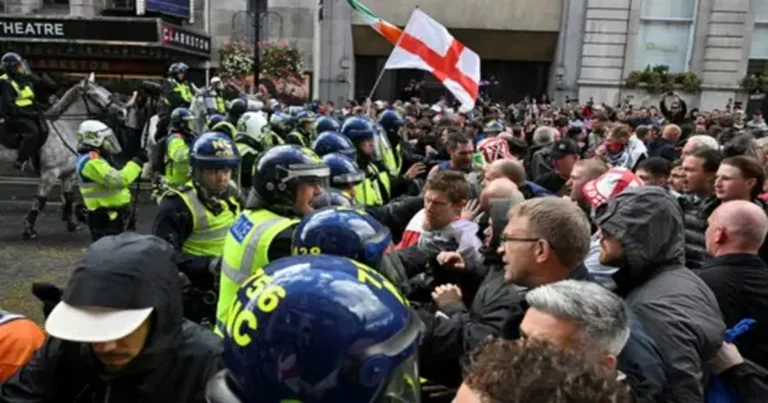
Tens of thousands of far-right supporters descended on central London on Saturday for the “Unite the Kingdom” rally led by activist Tommy Robinson, one of the largest demonstrations of its kind in modern British history. The event, which drew an estimated 110,000 participants, was met with a smaller but vocal counter-protest of approximately 5,000 anti-racism demonstrators, resulting in violent clashes with police and nine arrests.
Event Overview and Scale
The rally, organized by Robinson—whose real name is Stephen Yaxley-Lennon—saw supporters marching from Southwark to Whitehall, draped in Union Jacks and St. George’s flags. The event was billed as a celebration of “free speech” and British heritage but centered on anti-immigration rhetoric, with chants of “we want our country back” and signs reading “stop the boats” and “send them home”.
The counter-protest, organized by Stand Up To Racism (SUTR), marched under the banner “March Against Fascism,” holding signs that read “refugees welcome” and “smash the far right” . The Metropolitan Police deployed over 1,000 officers, including 500 borrowed from other forces, to maintain a “sterile area” between the two groups. Despite these measures, skirmishes broke out as Robinson supporters attempted to breach police cordons.
Clashes and Police Response
The protests turned violent in the late afternoon, with Robinson supporters throwing projectiles—including glass bottles, metal poles, and flares—at police officers. The Metropolitan Police reported “significant aggression” from the Unite the Kingdom group, with officers assaulted through kicks and punches. Reinforcements in riot gear and police horses were deployed to push back crowds attempting to access restricted areas.
Commander Clair Haynes, leading the police operation, stated that officers intervened in multiple locations to prevent breaches but faced “unacceptable violence” . Nine arrests were made for various offences, though police indicated that many more offenders had been identified and would face consequences.
Political and International Influences
The rally featured speeches from Robinson, who criticized UK courts for prioritizing migrant rights over those of the “local community,” and TV personality Katie Hopkins . In a surprise appearance via videolink, tech billionaire Elon Musk called for a “change of government” and the dissolution of Parliament, claiming, “the left is the party of murder” in reference to the recent killing of U.S. conservative activist Charlie Kirk.
Robinson also used the platform to mourn Kirk, whose death has become a rallying cry for far-right movements globally. Demonstrators held signs declaring “Freedom of speech is dead. RIP Charlie Kirk”.
Context and Community Impact
The rally occurs amid a highly charged summer in Britain, where immigration has dominated political discourse. Record numbers of asylum seekers crossing the English Channel have fueled anti-migrant protests, particularly outside hotels housing refugees. Robinson, a polarizing figure with criminal convictions for assault and fraud, has long been a vocal critic of Islam and immigration.
The Metropolitan Police acknowledged “particular concerns” among London’s Muslim communities due to past “anti-Muslim rhetoric” at Robinson’s events. Commander Haynes urged Muslim residents not to avoid central London but to report any concerns to officers.
Counter-Protest and Political Rebuttal
The counter-demonstration, though smaller, featured speeches from independent MP Diane Abbott and others who condemned the far-right’s messaging. Abbott stated, “We know racism and violence and fascism is not new… We have always defeated that racism and violence”.
Prime Minister Keir Starmer was notably absent from the events, watching a football match at Emirates Stadium as clashes unfolded. His government has faced criticism from both sides of the debate, with Robinson accusing politicians of “parroting” his ideas while failing to address immigration effectively.
Broader Implications
The scale of the rally highlights the growing influence of far-right movements in the UK and their ability to mobilize supporters around issues of nationalism and immigration. However, the event also exposed divisions within these groups, as Reform UK, Britain’s largest anti-immigrant political party, distanced itself from Robinson.
The clashes underscore ongoing tensions between free speech and hate speech, particularly as London grapples with balancing public safety with the right to protest. The Metropolitan Police’s decision to avoid live facial recognition technology at the event further complicates efforts to manage large-scale demonstrations.
Conclusion
Saturday’s events in London reflect a deeply divided political landscape, where immigration and national identity remain flashpoints. While Robinson’s rally demonstrated the far-right’s capacity to mobilize masses, the counter-protests and police response highlighted strong opposition to their messaging. As debates over migration and free speech continue, the aftermath of these protests will likely influence both policy and public discourse in the UK.


