Can Red Bull’s downforce gamble pay off at Spa?
Red Bull downforce Belgian GP strategy has raised eyebrows ahead of the Belgian Grand Prix, as the team made a significant shift in setup with one eye on possible rain and tire wear. While Max Verstappen’s fourth-place qualifying result may not scream dominance, the team believes their bold downforce adjustments could flip the race upside down—especially if weather plays a role.
Why did Red Bull change its downforce setup for the Belgian GP?
With the unpredictability of Spa-Francorchamps’ weather looming large, Red Bull opted to increase downforce significantly before Sunday’s race. The decision came after Verstappen’s strong sprint race performance in dry conditions, where a lower downforce setup gave him a speed edge on the straights.
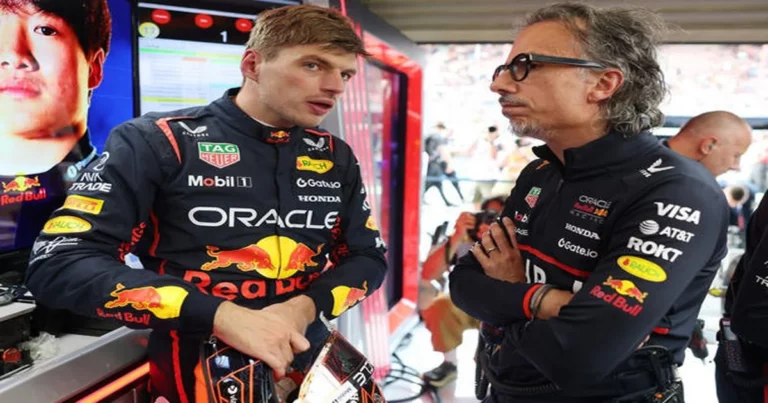
But Red Bull’s Laurent Mekies revealed that the team made intentional changes for wet conditions, knowing grip would be limited. “We’re not begging for rain,” Mekies told F1TV, “but we made several choices on the car assuming we’d get less grip. Obviously, we have increased our downforce significantly.”
The tradeoff? Verstappen lost the top-speed advantage that helped him during the sprint—now running nearly equal on telemetry with the McLarens.
How does increased downforce affect Red Bull’s race pace at Spa?
In dry conditions, increased downforce can be a double-edged sword at a track like Spa. While it helps through twisty sections and improves tire life, it sacrifices straight-line speed—especially important on the long Kemmel Straight.
This was evident in qualifying, where Verstappen was just fourth fastest, 0.3s off polesitter Lando Norris. His top-speed advantage disappeared, as Q3 conditions favored low-drag setups.
“Q3 was more difficult,” said Mekies. “Max had a slide out of La Source, which allowed Leclerc to beat us by three-thousandths. Still, we think our setup reflects the reality—we’re two to three tenths behind McLaren, and that’s where we fight from.”
Can Red Bull’s rain strategy close the gap to McLaren?
Mekies admitted that if rain does fall, Red Bull’s wet-oriented setup could close the performance gap to McLaren, who appear dominant in the dry.
“Rain is probably the best chance we have to reduce the gap,” he said. That’s also why Red Bull sacrificed qualifying position—to gain an edge if the track turns wet.
If showers hit during the race, Red Bull may find itself with the upper hand, especially given Verstappen’s known skill in the rain.
Will Verstappen’s wet-weather skills make the difference in Belgium?
Verstappen has a proven track record in wet races, and team advisor Helmut Marko is optimistic: “We’re expecting rain tomorrow, so it’s not a disappointment,” he told ORF.
Even though Verstappen wasn’t at his best in Q3—struggling with grip and possibly tire pressure—Marko said the focus is now entirely on the race. “Max had real slides in Turn 1 and 5. Maybe tire pressures weren’t perfect, but we’re optimistic. I don’t see a big issue with being beaten by Leclerc.”
What did Laurent Mekies say about Red Bull’s downforce gamble?
Mekies stressed that Sunday will be a complete reset. Whether dry or wet, he says the team has the car to fight: “It’ll be a big tire management game, even in the dry. If it’s wet, even better for us.”
The Red Bull downforce Belgian GP strategy could either be a stroke of genius or a missed opportunity—depending on Spa’s notoriously moody skies.
Did Helmut Marko defend Verstappen’s qualifying position at Spa?
Yes. Despite Verstappen only qualifying fourth, Marko was clear: “It’s not a disappointment. We’re focused on the race.” He added that Verstappen’s performance issues were likely tied to tire setup and grip—not outright pace.
Rain or shine, Red Bull’s gamble will be tested to the limit on race day.


