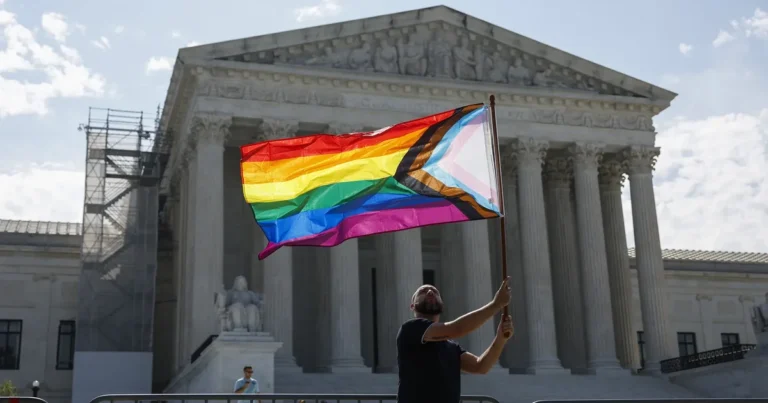
The U.S. Supreme Court on Tuesday appeared ready to side with a Christian therapist challenging Colorado’s ban on conversion therapy for minors, signaling a potential shift that could unravel similar laws across more than 20 states.
The justices heard oral arguments in Chiles v. Salazar, a closely watched case that could redefine the balance between free speech rights and state health regulations. The outcome may also influence how far governments can go in restricting what licensed professionals say during therapy.
Therapist Challenges Colorado’s 2019 Law
The challenge was brought by Kaley Chiles, a Christian counselor who argues that Colorado’s 2019 ban violates her First Amendment rights. The law prohibits licensed therapists from attempting to alter a minor’s sexual orientation or gender identity, though it exempts religious figures and family members.
Chiles says her therapy sessions consist solely of conversation — not medical treatment — and that the state’s restrictions amount to viewpoint discrimination, allowing therapists to affirm LGBTQ identities but not question them.
“The state cannot tell counselors which side of a moral question they’re allowed to take,” her attorneys said.
Conservative Majority Skeptical of State’s Arguments
During Tuesday’s arguments, several conservative justices — including Samuel Alito and John Roberts — pressed the state’s lawyers on why the ban should not be seen as an attempt to police thought and speech.
“When a law allows one message but bans another, that looks like viewpoint discrimination,” Justice Alito said.
Chief Justice Roberts noted that simply labeling therapy as “conduct” doesn’t remove its speech protections.
“Just because a professional is engaged in conduct doesn’t mean their words aren’t protected,” Roberts said, referencing a 2018 ruling that struck down a California law requiring anti-abortion clinics to promote abortion services.
The 6–3 conservative majority, which has consistently expanded free speech protections, appeared unconvinced that Colorado’s law targeted conduct rather than speech.
Liberal Justices Push Back
The court’s liberal wing raised deeper questions about how this case aligns with earlier decisions that upheld state power to regulate gender-affirming medical care.
Justice Ketanji Brown Jackson cited the court’s ruling from earlier this year that allowed states like Tennessee to ban gender-transition treatments for minors.
“It seems inconsistent to allow states to restrict one kind of therapy but not another,” Jackson said.
Still, the overall tone of the hearing suggested the court is leaning toward recognizing therapy conversations as protected speech — potentially setting a new national standard.
Trump Administration Supports Therapist’s Claim
The Trump administration filed a brief backing Chiles, arguing that Colorado’s ban “imposes unconstitutional speech restrictions” on licensed professionals. Representing the administration, attorney Hashim Mooppan told the justices that the First Amendment forbids states from “picking a side” in deeply personal counseling sessions.
“Under Colorado’s theory, Tennessee could have banned talk therapy that affirms gender transition,” Mooppan said. “That’s why this case matters far beyond conversion therapy.”
Potential Impact on State Laws Nationwide
If the Supreme Court strikes down Colorado’s law, the decision could jeopardize conversion therapy bans in more than 20 states, including California, New York, and Illinois. It may also invite new challenges to other state health regulations, including those governing abortion counseling or mental health treatment.
Legal analysts say the court appears poised to treat counseling as protected expression rather than medical conduct, requiring states to meet the toughest constitutional test — known as strict scrutiny.
Under that standard, any law limiting speech must serve a compelling government interest and be narrowly tailored to achieve it.
“This case could rewrite the boundaries of professional speech,” said Dr. Lisa Rubin, a legal scholar at Georgetown University. “If therapy is deemed pure speech, states will lose significant power to regulate mental health practices.”
Colorado Defends the Ban as Health Regulation
Colorado Attorney General Phil Weiser, a Democrat, urged the justices to uphold the law, saying it protects vulnerable minors from harmful and discredited practices.
“Conversion therapy has no medical basis and has caused serious psychological damage to countless youth,” Weiser said in court filings. “The state has a duty to regulate harmful medical conduct.”
He warned that overturning the law could “undermine public health oversight nationwide” by limiting states’ ability to set professional standards for licensed providers.
But several conservative justices questioned whether the state’s argument blurred the line between speech and conduct.
Justice Amy Coney Barrett asked whether the same reasoning could allow conservative states to impose “mirror-image” restrictions banning therapy that supports LGBTQ identities.
“Can a state favor one message over another?” Barrett asked.
Court Balancing Free Speech and LGBTQ Protections
The Supreme Court’s approach to LGBTQ rights has been mixed. It legalized same-sex marriage in 2015 and extended employment protections to gay and transgender people in 2020.
However, it has also repeatedly sided with religious freedom and free speech claims when those rights conflict with anti-discrimination laws.
This year, the justices ruled in favor of a religious challenge to a Maryland school district’s inclusion of LGBTQ-themed books, saying parents could not be forced to expose their children to materials that contradicted their beliefs.
The conversion therapy case represents another intersection of those two themes: speech versus regulation, faith versus identity.
Possible Narrow Ruling
Some court watchers expect the justices to issue a limited ruling rather than striking down all conversion therapy bans outright. They may remand the case to lower courts to apply strict scrutiny — forcing judges to reconsider whether Colorado’s law truly serves a compelling interest.
Even a narrow ruling, though, could trigger a wave of litigation challenging professional speech restrictions nationwide.
“The ripple effects could reach everything from medical counseling to parental consent laws,” said Jonathan Adler, professor of constitutional law at Case Western Reserve University.
A final decision is expected by June 2026.


