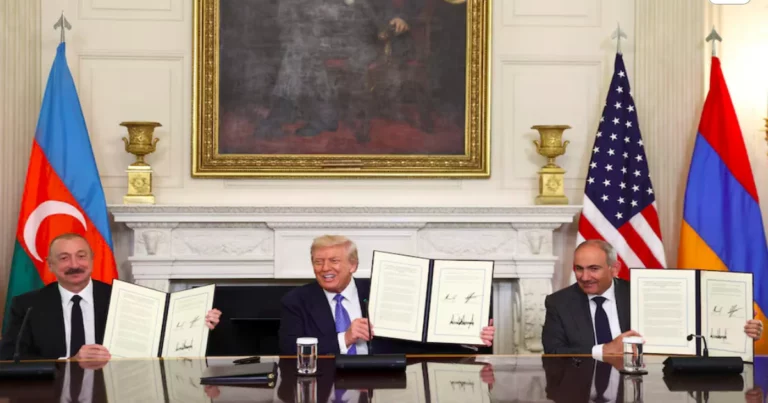
Armenia and Azerbaijan signed a U.S.-brokered peace agreement on Friday at the White House, marking a potential turning point in their decades-long conflict. U.S. President Donald Trump hosted the ceremony, where both sides pledged to strengthen economic ties.
The agreement between the South Caucasus neighbors, if upheld, represents a notable diplomatic win for the Trump administration and is likely to unsettle Moscow, which has long considered the region part of its influence.
“It’s a long time — 35 years — they fought and now they’re friends, and they’re going to be friends for a long time,” Trump said during the signing, standing alongside Azerbaijani President Ilham Aliyev and Armenian Prime Minister Nikol Pashinyan.
The two nations have been at odds since the late 1980s, when Nagorno-Karabakh, a mountainous region within Azerbaijan populated mainly by ethnic Armenians, broke away with Armenian backing. Azerbaijan regained full control in 2023, prompting nearly all of the region’s 100,000 ethnic Armenians to relocate to Armenia.
Trump said the peace deal includes commitments to end hostilities, establish diplomatic relations and respect each other’s territorial integrity. It also grants the United States exclusive development rights to a strategic South Caucasus transit corridor, intended to boost energy and resource exports.
Separate agreements between the United States and each country will expand cooperation in energy, trade and technology, including artificial intelligence. Restrictions on defense cooperation between Washington and Baku have also been lifted.
Both leaders praised Trump’s role in achieving the accord and said they would nominate him for the Nobel Peace Prize. “So who if not President Trump deserves the Nobel Peace Prize?” Aliyev said.
Since starting his second term, Trump has sought to position himself as a global mediator, with the White House crediting him for peace efforts between Cambodia and Thailand, Rwanda and the Democratic Republic of the Congo, and Pakistan and India. However, he has not yet resolved Russia’s war in Ukraine or Israel’s conflict with Hamas in Gaza.
U.S. officials said the deal was the result of repeated high-level visits to the region and would serve as a foundation for full normalization. Senior administration members described it as the first resolution of several long-standing disputes on Russia’s periphery since the Cold War, calling it a strong signal to the broader region.
The South Caucasus, an energy-producing area bordering Russia, Europe, Turkey and Iran, has long been divided by closed borders and ethnic tensions despite its network of vital oil and gas pipelines. Armenia will grant the United States exclusive special development rights for the transit corridor, known as the Trump Route for International Peace and Prosperity, which has already attracted interest from nine companies, including three American firms, according to officials.
Daphne Panayotatos of Freedom Now urged the administration to press Aliyev for the release of about 375 political prisoners in Azerbaijan. Baku, which hosted the U.N. climate summit last November, has dismissed Western criticism of its human rights record, calling it unwarranted interference.


