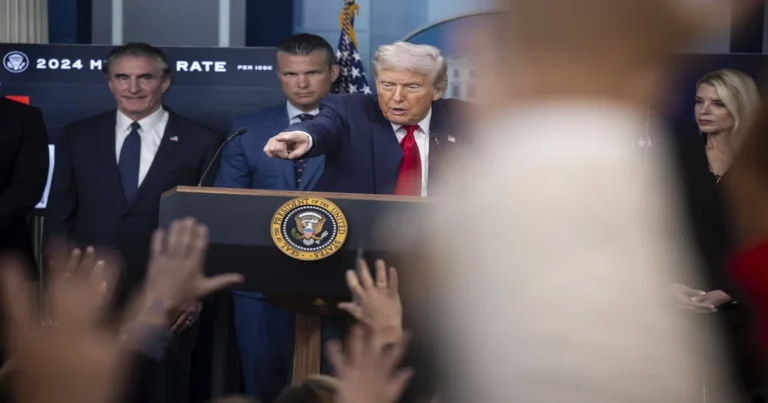
Trump defended his decision to approve a deal allowing Nvidia to obtain an export control license, saying he would not permit the company to sell its more advanced Blackwell chip to China unless it was altered “in a negative way.” Nvidia CEO Jensen Huang visited Washington last week for a meeting with Trump at the White House.
The comments followed reports that Nvidia and AMD agreed to pay the U.S. 15 percent of their revenue from sales of artificial intelligence chips in China in exchange for the license.
Nvidia created the H20 chip for the Chinese market after the Biden administration restricted exports of more advanced chips. The Trump administration banned H20 sales to China earlier this year but reversed the decision ahead of trade negotiations in July. Around that time, Nvidia said the administration assured the company new export licenses would be approved.
“We follow rules the U.S. government sets for our participation in worldwide markets,” a Nvidia spokesperson said Monday. “While we haven’t shipped H20 to China for months, we hope export control rules will let America compete in China and worldwide. America cannot repeat 5G and lose telecommunication leadership. America’s AI tech stack can be the world’s standard if we race.”
Chris Padilla, a Commerce Department official under President George W. Bush, said the deal may violate the U.S. Export Control Reform Act, which prohibits fees “in connection with the submission, processing, or consideration” of an export control license.
Other former officials, including Peter Harrell, who served as senior director for international economics in the Biden White House, warned the arrangement could also breach the constitutional ban on export taxes.
A White House spokesperson did not immediately address questions about the legality or constitutionality of the move.
Padilla, who served as assistant secretary at the Bureau of Industry and Security, said he was “flabbergasted” that Trump would use national security export controls to secure payments from companies. He said this sets a “dangerous” precedent, as export controls are meant to prevent foreign access to technology that could be used militarily against the U.S.
“How do you put a price on selling something that could endanger the lives of American servicemen, or put at risk our technological advantage in a militarily critical technology,” Padilla said.
Stephen Olson, a former U.S. trade official at the ISEAS think tank in Singapore, said if the H20 chip does not pose a national security threat, as Trump suggested, then charging a fee for a license is inappropriate.
“To call this unusual or unprecedented would be a staggering understatement. What we are seeing is in effect the monetization of U.S. trade policy in which U.S. companies must pay the U.S. government for permission to export. If that’s the case, we’ve entered into a new and dangerous world,” Olson said.


