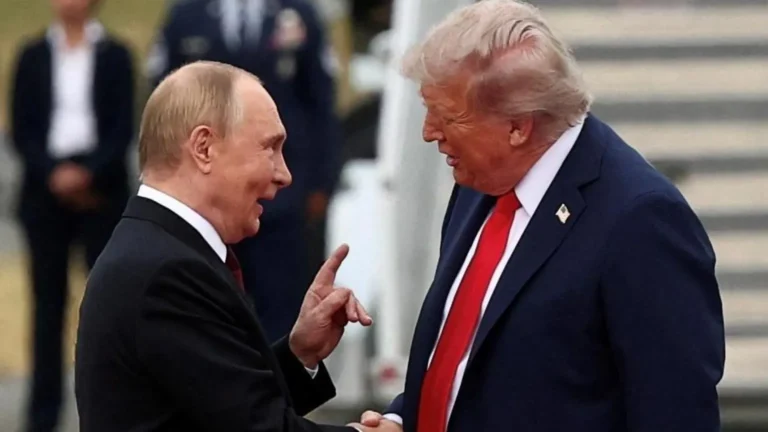
Plans for a high-profile meeting between U.S. President Donald Trump and Russian President Vladimir Putin have been abruptly shelved, just days after both leaders discussed holding talks in Budapest to negotiate an end to the war in Ukraine.
A White House official confirmed Tuesday that there are “no plans for President Trump to meet with President Putin in the immediate future.” The announcement came less than a week after Trump declared that he and Putin would hold direct talks in Hungary within two weeks.
A preparatory session between Secretary of State Marco Rubio and Russian Foreign Minister Sergei Lavrov, initially planned for this week, was also called off. Officials said the two diplomats held a “productive phone conversation” instead, and that an in-person meeting was “no longer necessary.”
The White House declined to explain why the summit was canceled. However, diplomatic sources indicated that widening rifts over peace proposals — particularly the future of eastern Ukraine — had derailed progress toward a Trump-Putin summit.
Trump reportedly discussed the idea of a Budapest meeting with Putin by phone, one day before hosting Ukrainian President Volodymyr Zelensky at the White House. Media reports described that meeting as tense, with Trump allegedly urging Zelensky to cede parts of Donetsk and Luhansk — the Donbas region — to Russia as part of a settlement.
Zelensky rejected that notion, insisting that Ukraine cannot surrender any of its remaining territory, arguing that doing so would invite further Russian aggression.
On Monday, Trump appeared to endorse a ceasefire plan supported by Kyiv and European allies, which would freeze fighting along the current front line.
“Let it be cut the way it is,” Trump said. “Cut and stop at the battle line. Go home. Stop fighting, stop killing people.”
But Moscow has dismissed such proposals. Kremlin spokesman Dmitry Peskov reiterated that Russia’s stance “has not changed,” insisting that Ukraine must withdraw entirely from the eastern regions.
Foreign Minister Lavrov also rejected the idea of freezing the conflict, claiming Russia seeks “long-term, sustainable peace,” not what he called a temporary truce. He repeated Moscow’s broader demands — including full control of the Donbas and demilitarization of Ukraine — terms viewed as unacceptable by Kyiv and Western nations.
Earlier Tuesday, European leaders issued a joint statement with Zelensky supporting the front-line freeze as a first step toward peace and accused Russia of not being serious about negotiations.
The two leaders last met in Anchorage, Alaska, in August, a summit that produced no tangible results. Analysts suggest the White House may have canceled the proposed Budapest talks to avoid another unproductive encounter.
“The Russians wanted too much, and it became clear there would be no deal for Trump in Budapest,” a senior European diplomat told Reuters.
Zelensky described current discussions about the battle lines as “the beginning of diplomacy,” accusing Russia of deliberately avoiding dialogue. He added that only the threat of long-range U.S. weapons, such as Tomahawk missiles, had pushed Moscow to engage at all.
Putin’s unexpected call to Trump last week followed speculation that the U.S. was preparing to send Tomahawks to Ukraine — missiles capable of reaching deep inside Russian territory.
Zelensky suggested that Washington’s missile diplomacy had forced Moscow’s hand:
“The talk about Tomahawks turned out to be a strong investment in diplomacy,” he said.


