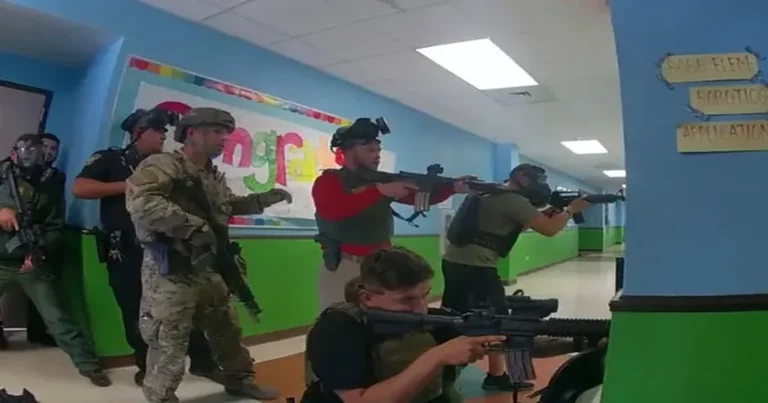
Newly released video shows Uvalde school police chief Pete Arredondo attempting to negotiate with the gunman during the 2022 mass shooting at Robb Elementary School, rather than ordering an immediate entry into the classroom. The footage is part of law enforcement materials made public on Tuesday after years of resistance to their release.
Arredondo, who was the first senior officer on scene, believed the attacker was no longer an active shooter but a barricaded subject. That assessment is central to his upcoming trial, where he faces charges of abandoning or endangering the children under his protection. Nineteen children and two teachers were killed, and 17 others injured.
The videos show Arredondo spending more than 30 minutes trying to persuade the gunman, who remained inside two connected classrooms with two teachers and 28 students, to surrender. At least some of those inside were still alive. “Individual in room 111 and 112, this is Arredondo, can you please put your firearm down?” he called through the door at 11:59 a.m., about 30 minutes after the attack began. He repeated the requests in English and Spanish, without response.
“We don’t want anyone else hurt, sir,” he said. “These are innocent children, sir.” Meanwhile, officers from multiple agencies gathered nearby, some voicing frustration over the delay. “If we need to jump in, we’ll jump in,” one officer said at 12:21 p.m., according to body camera footage. Two minutes later, Arredondo again pleaded, “Please don’t hurt anyone. These are innocent children.”
When asked if the gunman had responded, officers confirmed he had not. Seventy-seven minutes after the first shots, a Border Patrol tactical unit entered the classrooms, killing the gunman.
Investigations by the U.S. Justice Department and the Texas Department of Public Safety concluded Arredondo made a critical error by not treating 18-year-old Salvador Ramos as an active threat. Gregory M. Vecchi, a retired FBI crisis negotiator, said mass shooting protocols require immediate action to neutralize the shooter. “There is no barricade. There is no negotiation,” he said.
Initial attempts by officers to enter the classrooms failed when Ramos fired through the door, grazing two officers. Arredondo has said he concentrated on evacuating other classrooms and waited for better-equipped backup while trying to talk the gunman into surrendering. He and fellow school district officer Adrian Gonzales, who also faces charges, maintain they acted appropriately.
Body camera footage from a Uvalde County sheriff’s deputy shows officers in the hallway discussing whether the classroom door was locked and if it needed to be breached. The footage cuts off before showing any attempt to open it. Later findings revealed the door was unlocked.
The delay may have cost lives. While most victims had already been shot, some wounded students and a teacher were still alive, and at least one child called 911 during the standoff. A surviving teacher told The New York Times he was shot twice and heard another child shot in the adjacent room during the wait.
The release of thousands of pages and videos by county and school district officials follows a prolonged legal battle with media organizations, including The Times. Written accounts from deputies describe being told not to engage without authorization, citing possible crossfire risks.
Footage shows the chaotic end of the standoff at 12:50 p.m., when gunfire erupted and officers rushed in. Two minutes later, Arredondo appeared behind officers searching for survivors. One officer instructed, “Anyone who is not a medic, please clear out.”
By then, over 370 officers from various agencies had responded, many remaining outside. Arredondo has said he did not consider himself in command once others arrived, though state officials said he was the de facto incident commander. Several senior officers have since been fired or retired.
The documents also reveal details about Ramos’s troubled history. Early school records described him as a “sweet little boy,” but by 2018 he was frequently involved in fights, with one report noting he struck a classmate, prompting retaliation. Teachers had struggled to address his escalating behavior.


